Knowledge

Food Packaging Certifications Guide: FDA, LFGB, FSC, BPI & EN13432 Explained for Buyers

Author : Hydepackage
Update time : 2026-07-16 15:02:07
89666

No matter if it's importing disposable food packaging, food packaging manufacturer China, looking for compostable packaging, or comparing FDA and LFGB, choosing certified packaging suppliers, certification is the first thing for buyers. A package might look sturdy and eye-catching, but without the right certifications, it may not comply with the legal, safety, or sustainability standards required in your market.
 
We frequently see like FDA, LFGB, FSC, BPI, and EN13432 listed. Yet many buyers aren’t entirely clear on what each certification actually means, which markets demand them, or how they apply to specific items like paper cups, food container packaging, bio-compostable tableware, and custom food packaging.
 
This guides five key food packaging certifications by HydePackage.

 
custom certified food packagingWhich five food packaging certifications are the most important?
 
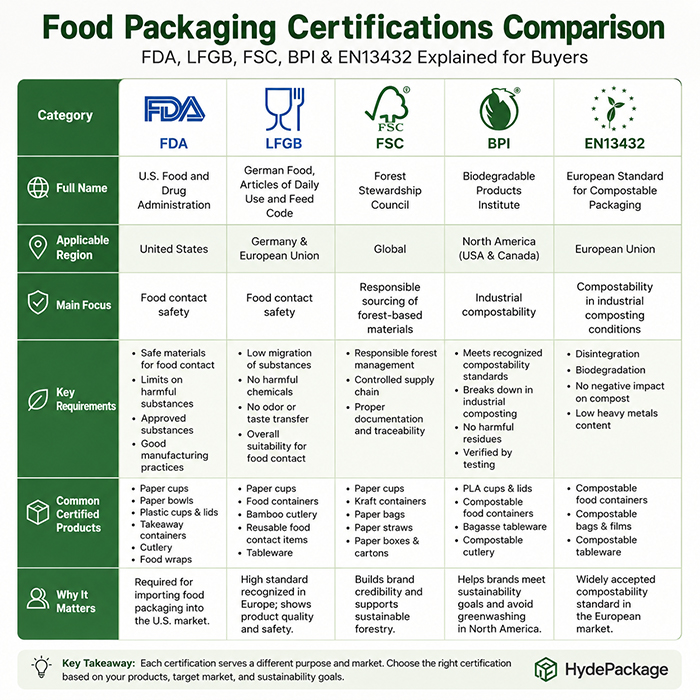
The FDA ensures the safety of food contact in the United States. The LFGB covers the strict requirements for food contact materials in Germany and Europe. The FSC certifies responsible procurement of paper materials. The BPI verifies the industrial compostability in North America. And EN 13432 stipulates the compostability standards for the European market.
 
Why Food Packaging Certifications are Important
 
Food packaging is in direct or indirect touch. So, packaging materials have to comply with stringent standards in terms of food safety, chemicals, hygiene, and environmental responsibility.
 
Certifications help buyers answer key questions before they order:
 
1. Is the packaging suitable for food grade?
2. Is it compliant with regulations in the destination market?
3. Is the material tested by a recognized standards or certifying body?
4. Are claims of sustainability such as “compostable” or “responsibly sourced” verifiable?
5. How packaging helps a brand’s environmental goals and consumer trust
 
Also provides transparency and credibility to manufacturers and suppliers by providing certification documents. Buyers are more likely to trust suppliers who can provide valid test reports, declarations of conformity and certification records in support.


FDA Certification: Food Safety Certification
 
What is FDA certification?
 
1.Food and Drug Administration
2.refers to regulations established by the
3.Food and Drug Administration
4.in the United States. In food packaging, the key concern is whether the materials used are safe for contact with food under applicable FDA regulations.
 
What does FDA compliance cover?
 
1.Safety of materials used in direct food contact
2.Limits on harmful substances migrating into food
3.Use of approved substances for packaging applications
4.Manufacturing help maintain product safety
 
Which products require FDA authorization?
 
1. Paper cups and disposable coffee cups
2. Disposable paper bowls and soup containers
3. Disposable plastic cups and lids
4. Disposable takeaway food containers
5. Disposable cutlery
6. Food packaging films and wraps
 
Why is FDA compliance important?
 
If you are importing food packaging into the United States, FDA compliance is a basic requirement for demonstrating that the packaging is suitable for food contact. Buyers in the U.S. often request FDA food contact declarations or supporting test reports before approving a supplier.
 
It is important to note that FDA compliance for packaging materials is generally not a certificate issued by the FDA itself. Instead, it usually refers to compliance with applicable FDA regulations and supporting test documentation.


LFGB Certification: A Key Standard for Germany and Europe
 
What is LFGB?
 
LFGB stands for Lebensmittel- und Futtermittelgesetzbuch, the German Food and Feed Code. It is one of the strictest food contact standards in Europe and is widely recognized by European buyers.
 
What does LFGB testing evaluate?
 
1. Migration of substances from packaging into food
2. Presence of harmful chemicals
3. Odor and taste transfer
4. Overall suitability for food contact
 
When is LFGB important?
 
Exporting food packaging to Germany,Selling products in European markets with strict buyer requirements
 
Supplying premium foodservice or retail packaging
 
Providing additional assurance beyond basic food contact compliance
 
Why do buyers request LFGB certification?
 
LFGB testing is often seen as a great indicator of product quality and safety. The standard is stringent, and many buyers consider LFGB compliance as a standard while choosing the supplier of food packaging products such as paper cups, bamboo cutlery, and reusable food contact items.


FSC Certification: Paper Materials
 
What is the meaning of FSC?
 
The Forest Stewardship Council is an international group that promotes responsible management of the world’s forests. FSC certification is mainly used for paper, paperboard and packaging made from wood.
 
The certified material is properly controlled and documented
 
Common FSC certified packaging products
 
1. Paper cups
2. Kraft paper food containers
3. Paper bags
4. Paper straws
5. Paper boxes and cartons
 
Why FSC important for food packaging
 
For paper-based food packaging, FSC certification is especially valuable for brands that want to communicate a stronger environmental message.


BPI Certification: in North America
 
What is the BPI?
 
Biodegradable Products Institute is a leading certification organization in North America for compostable products and packaging.
 
What does BPI certification verify?
 
1. The product meets recognized compostability standards
2. The material can break down in industrial composting conditions
3. The product does not leave harmful residues after composting
4. The compostability claim is supported by testing and certification
 
Products commonly certified by BPI
 
1. PLA cups and lids
2. Compostable food containers 
3. Bagasse tableware
4. Compostable cutlery
5. Biodegradable food packaging products
 
Why is BPI certification requirements?
 
In North America, especially in markets with composting infrastructure and sustainable development regulations, BPI certification helps buyers identify packaging products that are truly compostable under industrial composting conditions, and also reduces the risks associated with misleading environmental claims.


EN13432 Certification: The European Compostability Standard
 
What is EN13432?
 
EN13432 is one of the most well-known standards for compostability of food packaging sold in the European market. When buying compostable packaging products for restaurants, retail chains and eco-conscious brands, buyers often request EN13432 test reports or certification.
 
There are a number of key criteria a product must satisfy to be deemed compostable. It should decompose at the start of the composting process, breaking down into small particles without visible residues. The produced compost should also be eco-friendly. It should promote the growth of healthy plants and maintain the quality of the soil without any adverse effects. The material must be low in heavy metals and other restricted substances, and must meet safety standards to ensure the compost is suitable for agricultural and environmental applications.
 
Which products are usually tested for EN13432?
 
1. Bagasse food containers
2. PLA packaging
3. Bio-compostable cups and lids
4. Disposable compostable trays and plates
5. Biodegradable takeout food packaging
 
Why are EN13432 important in Europe?
 
For food packaging sold in the European market, EN13432 is one of the most recognized standards for compostability. Buyers often request EN13432 test reports or certification when sourcing compostable packaging products for restaurants, retail chains, and environmentally focused brands.


How to Make the Right Choice of Certification for Your Packaging

custom certified food packaging
 
The certification depends on the packaging material, the product type and your target market. Some guidelines are provided below:
 
If you are selling in the United States check that food packaging materials comply with FDA food touch regulations.
 
If the product is compostable, BPI certification can make the environment stronger.
 
If you are selling in Europe, particularly in Germany, you might be asked for LFGB on food products.
 
EN13432 is important for compostable packaging.
 
If your packaging is paper-based
 
FSC certification helps demonstrate responsible sourcing of paper materials.
 
FDA or LFGB compliance may also be needed depending on the destination market.
 
If your packaging is compostable
 
BPI is relevant for North America.
 
EN13432 is relevant for Europe.
 
Additional food contact compliance may still be required.


What Buyers Should Ask Suppliers
 
When assessing a good food packaging supplier, buyers should request clear documentation. Useful questions include:
 
1. Can you provide FDA or LFGB food test reports?
2. Does the paper material have FSC certification?
3. Does the compostable product have valid BPI or EN13432 certification?
4. Are the test reports issued by recognized entities?
5. Do the reports correspond to the exact product and material purchased?
 
Requesting these documents helps reduce compliance risks and ensures that the packaging meets the requirements of your target market.
 
Common Misunderstandings About Packaging Certifications, FDA approved means the FDA issued a certificate
 
For food packaging materials, FDA compliance usually means the material complies with applicable FDA regulations. It does not necessarily mean the FDA has issued a specific certificate for the finished packaging product.
 
"Biodegradable" and "compostable" are often used interchangeably, but they’re not exactly the same thing. such as those certified under BPI or the EN13432 standard, are rigorously tested to break down completely in controlled composting conditions, leaving behind no harmful residues.
 
FSC certification guarantees food safety
 
FSC certification confirms responsible sourcing of forest-based materials, but food contact safety is addressed by standards such as FDA or LFGB.
 

Why Certified Packaging Supports Brand Trust
 
Food packaging is not only a food container. It is part of a brand’s quality and sustainability. Certifications help businesses communicate that their packaging has been evaluated according to recognized standards.
 
There are several business benefits to certified packaging:
 
Higher consumer confidence: inclined to trust products with verified safety and sustainability claims.
Easier access to markets: assist products in meeting import and retail requirements.
Brand positioning: Certifications help to support environmentally conscious branding.
Less risk of non-compliance: prevent food safety and labelling claims issues.
 

How Hydepackage Supports Certified Food Packaging
 
Hydepackage understands that different markets require different certification priorities. As a supplier of disposable food packaging, Hydepackage works with customers to provide packaging solutions that align with relevant food safety and sustainability standards.
 
Depending on the product category and customer requirements, Hydepackage can support packaging projects with considerations related to:
 
FDA-compliant food contact materials for the U.S. market
LFGB testing support for European food contact requirements
FSC-certified paper materials for responsibly sourced paper packaging
BPI-certified compostable products for North American compostable packaging needs
EN13432-compliant compostable solutions for European compostability requirements
 
By working with a supplier that understands certification requirements, buyers can simplify the sourcing process and ensure that the selected packaging is suitable for the intended market.


disposable food packaging supplier
 

Conclusion

Anyone sourcing food packaging for international markets needs to understand FDA, LFGB, FSC, BPI and EN13432 certifications.
 
FDA: Food Contact Safety in the United States
LFGB guarantees strict food contact safety for Germany and Europe.
FSC supports responsible use of paper and wood-based products.
BPI certifies industrial compostability in North America.
EN13432 sets out the conditions for packaging to be compostable in Europe.
 
Choosing the right certification in the right target market and the right packaging material can help you improve compliance, strengthen sustainability claims and build greater trust with customers.
 
Hydepackage can help you find the right packaging solutions and provide the documentation you need for your market needs if you need custom food packaging, compostable tableware, or certified paper packaging, request free samples or certification documents today.
Related News
Read More >>
Custom Food Packaging Manufacturer: OEM & Wholesale Buying Guide Custom Food Packaging Manufacturer: OEM & Wholesale Buying Guide
Jul .07.2026
Discover the best custom food packaging manufacturer for OEM and wholesale. Sustainable solutions including paper cups, bagasse containers, kraft boxes and more. Expert tips on choosing suppliers, customization, and certifications.
Bagasse vs Plastic Food Containers Bagasse vs Plastic Food Containers
Jul .01.2026
Compare bagasse vs plastic food containers. Learn differences in sustainability, cost, durability, and performance. Find eco-friendly food packaging solutions from Hydepackage.
Complete Buying Disposable Egg Trays Australia: Paper Egg Trays vs Plastic Egg Trays Complete Buying Disposable Egg Trays Australia: Paper Egg Trays vs Plastic Egg Trays
Jun .23.2026
Looking for disposable egg trays in Australia? Compare paper egg trays and plastic egg trays. Find eco-friendly egg packaging solutions for farms, supermarkets, and wholesalers.
The Best Compostable Garbage Bags The Best Compostable Garbage Bags
Jun .18.2026
The best eco-friendly compostable garbage bags are usually made of materials such as corn starch, PBAT, and PLA. These trash bags raw materials can be completely decomposed into water
inquire